
analysis
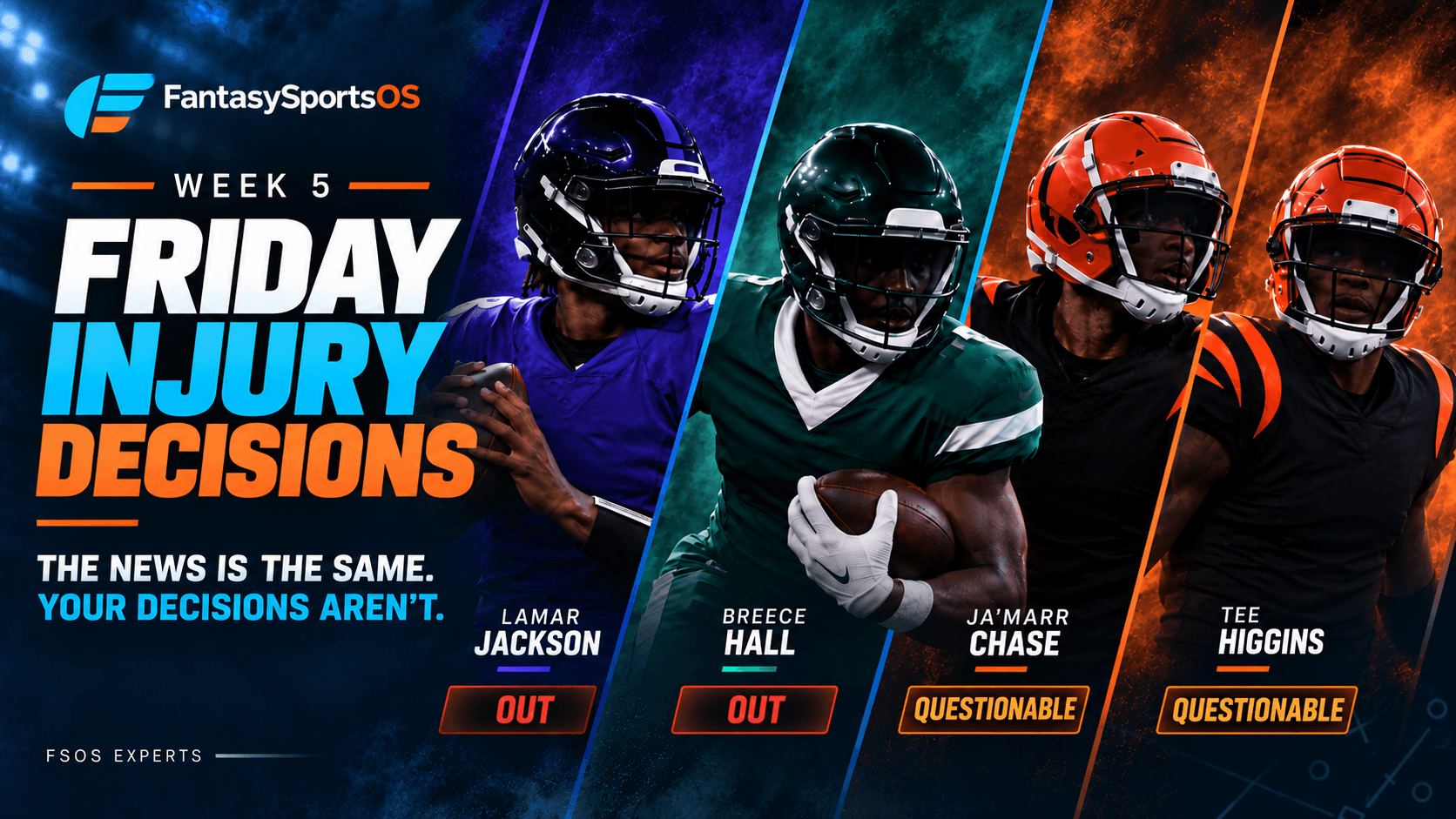
Friday Injury Decisions: Lamar Jackson and Breece Hall Out; Chase and Higgins Questionable
Lamar Jackson and Breece Hall are out. Ja’Marr Chase and Tee Higgins remain questionable. Here’s what to handle now—and what still needs a backup plan.
Published
Status snapshot: Friday, October 9, 2026. This article covers Week 5. Recheck team updates before making your final lineup decisions.
An injury report gives you information. It does not give you a plan.
There is a difference between knowing your starting quarterback is out and having a replacement you can actually use. There is also a difference between seeing “questionable” beside a receiver’s name and deciding he belongs on your bench. The designation starts the work. Your roster, alternatives, and deadlines determine the rest.
For Week 5, Baltimore has ruled out Lamar Jackson, and the Jets have ruled out Breece Hall. Cincinnati has listed Ja’Marr Chase and Tee Higgins as questionable. Those are four important names, but they do not represent four identical problems.
The job this weekend is to separate the decisions you can settle now from the ones that still need information. Then make sure waiting for that information does not cost you your best alternative.
Lamar Jackson: replace the starter, not the name
Baltimore has ruled Jackson out against Atlanta with an ankle injury after he missed practice throughout the week. Tyler Huntley will start Sunday night. For this game, Jackson’s availability is no longer an open question.
Your replacement might be.
Start with the leagues where Jackson is in your starting lineup. In each one, identify the best eligible quarterback you already roster, then compare him with anyone you can realistically acquire. Huntley belongs in that evaluation, but he should not win it automatically because he wears the same uniform.
Huntley inherits the start. He does not inherit Jackson’s fantasy projection.
In a one-quarterback league, you may prefer an available starter from another offense. In a two-quarterback or superflex league, your realistic options may be much narrower. The useful question is not whether Huntley is a replacement for Baltimore. It is whether he is your best available replacement in this particular league.
The Sunday-night kickoff also deserves attention. Jackson has already been ruled out; there is no benefit in waiting until Baltimore plays to begin solving your quarterback spot. A preferred alternative may play earlier. Work backward from that player’s deadline, not Jackson’s.
Treat the rest of your Baltimore players as separate comparisons. A quarterback change is a reason to reassess the offense, not a command to bench everyone attached to it. Consider what you expect to change, then compare each player with the alternative you actually have.
Breece Hall: opportunity matters, but somebody still has to block
The Jets have ruled Hall out against Cleveland with a quadriceps injury. They will also be without starting left guard Dylan Parham, who has a knee injury. That second piece of information belongs in the evaluation, too.
Braelon Allen has a recent workload worth examining. Against Chicago in Week 4, he carried 14 times for 59 yards and caught two passes for eight yards. That is evidence of an offensive role—not merely a backup’s name moving up a depth chart.
My read: Allen deserves a serious look as a replacement candidate. But “more opportunity” and “automatic start” are not the same conclusion.
Carries still need somewhere to go. Blocking, passing-game involvement, and the offense’s ability to sustain drives all belong in your evaluation. Parham’s absence is one reason not to treat Hall’s missing workload as a clean transfer of Hall’s expected production. It is a factor to consider, not proof that Allen will struggle.
For a multi-league manager, this creates two distinct reviews. Where you start Hall, you need a replacement. Where you roster Allen, you need to compare his opportunity with your current running backs and FLEX options. You can have an Allen decision in a league where you do not own Hall at all.
And do not confuse removing Hall from this week’s starting lineup with removing him from your roster. A weekly absence is not, by itself, a reason to discard a player.
Solve the open position. Do not manufacture another problem in the process.
Ja’Marr Chase: full practice is useful information, not the final answer
Cincinnati’s Friday report lists Chase as questionable with a concussion. He progressed from no participation Wednesday to limited participation Thursday and full participation Friday. The Bengals’ Friday preview also reported that he remained in concussion protocol.
Those details belong together. Reporting only the full practice leaves out the unresolved game status. Reporting only the concussion leaves out the change in participation.
NFL clearance requires approval from both the team physician and an independent neurological consultant.
That is a medical determination, not something fantasy managers should try to settle from a practice clip.
Your part is preparation. Name the player you would use if Chase does not play, confirm that the replacement is eligible, and determine when that option stops being available. Then follow the clearance and game-status updates rather than treating every repeated headline as a fresh development.
Consider a hypothetical pair of leagues. In one, you have a healthy receiver on the bench whom you would be comfortable starting. In the other, your only alternative is also uncertain. Chase has the same injury designation in both leagues, but the second roster needs more work now.
You do not have to bench Chase on Friday to prepare for Sunday. You also should not leave the entire plan at “hopefully he plays.”
Waiting is a decision. Make sure you know what you are keeping available while you wait.
Tee Higgins: the same designation does not mean the same situation
Higgins is also questionable, but Cincinnati lists his injuries as groin and neck. He missed Wednesday and Thursday’s practices before participating fully Friday.
That is a different set of circumstances from Chase’s concussion protocol. Grouping both players under “Bengals receivers are hurt” makes a tidy headline, but it is not a complete lineup evaluation.
For Higgins, keep two questions separate: will he play, and what would make you prefer him to your alternative? If he is active, look for credible information about any expected limitations. Do not invent a snap restriction because the injury sounds concerning, and do not assume full participation Friday guarantees a particular workload Sunday.
There is another trap here: assuming a Chase absence would automatically make every Higgins decision easier. That would change the personnel available to Cincinnati, but Higgins’ own condition would still matter. More potential opportunity does not erase uncertainty elsewhere in the evaluation.
The same discipline applies to the receivers behind them. Cincinnati’s own preview identifies Dohnte Meyers and Mitch Tinsley as players who could have larger roles depending on availability. That is a reason to examine them in deeper leagues—not a reason to assign either player all of the missing production.
Think through the combinations: both active, only one active, or both unavailable. You do not need three transactions. You need to understand which version would change your choice.
The deadline is part of the decision
Cincinnati plays Miami on Sunday, October 11, at 1 p.m. Eastern. That gives Chase and Higgins managers an early-game checkpoint, but it does not mean every necessary transaction can wait until then.
Your league’s acquisition rules matter. Sleeper supports different waiver configurations, including custom daily processing. A player appearing on the available-player list is not necessarily someone you can add immediately. Check the actual settings before building a plan around him.
A useful backup plan has three parts: a player, an eligible lineup position, and a deadline. “I’ll find somebody Sunday” has none of them.
Also check for overlap. If Chase and Higgins are both on one of your teams, the same bench receiver cannot fill both starting positions if both sit. A fallback that looks sufficient while you review each player separately can fall apart when you look at the whole lineup.
Sleeper AutoSubs can help in leagues that enable them, but their rules are specific. The pairing locks when either player’s game begins, each substitute can be assigned only once, and leagues can require the substitute to play at the same time or later. The substitution is triggered by an inactive starter—not simply a disappointing performance from an active player.
Know which mechanism you are relying on. A manual replacement plan and an AutoSub pairing are not interchangeable.
Handle the known decisions. Put a plan around the rest.
Here is how to make this manageable across your leagues: start with the confirmed absences, identify the starting positions they affect, and select usable replacements. Then review the unresolved players and preserve an alternative for each situation that still needs one.
A situation is not handled because you read the report. It is handled when you have made the necessary move and checked the resulting lineup—or deliberately left the decision open with a workable next step.
That is the point of managing a portfolio instead of treating every league as a separate investigation. Read the development once. Find the affected teams. Respect the different choices in each one.
You are not trying to win an argument with the injury report. You are trying to put the best available lineup on the field with the information and options you have.
The news is the same. Your decisions aren’t.
Sources
- Baltimore Ravens — Lamar Jackson Ruled Out vs. Falcons
- New York Jets — Jets Will Be Without Three Offensive Starters vs. Browns
- New York Jets — Braelon Allen: 2026 Game Log
- Cincinnati Bengals — Week 5 Injury Report: Bengals at Dolphins
- Cincinnati Bengals — What to Watch For: Bengals at Dolphins
- NFL — Return-to-Participation Protocol
- Sleeper — Waivers for Regular Season & Playoffs
- Sleeper — How Does Player AutoSubs Work?
A clearer view of your whole portfolio.
Apply for FSOS early access.