
guide
A Pre-Kickoff Checklist for Multi-League Fantasy Managers
A checklist does not replace decision-making. It keeps avoidable mistakes from getting in the way of the decisions that matter.
Published · Updated
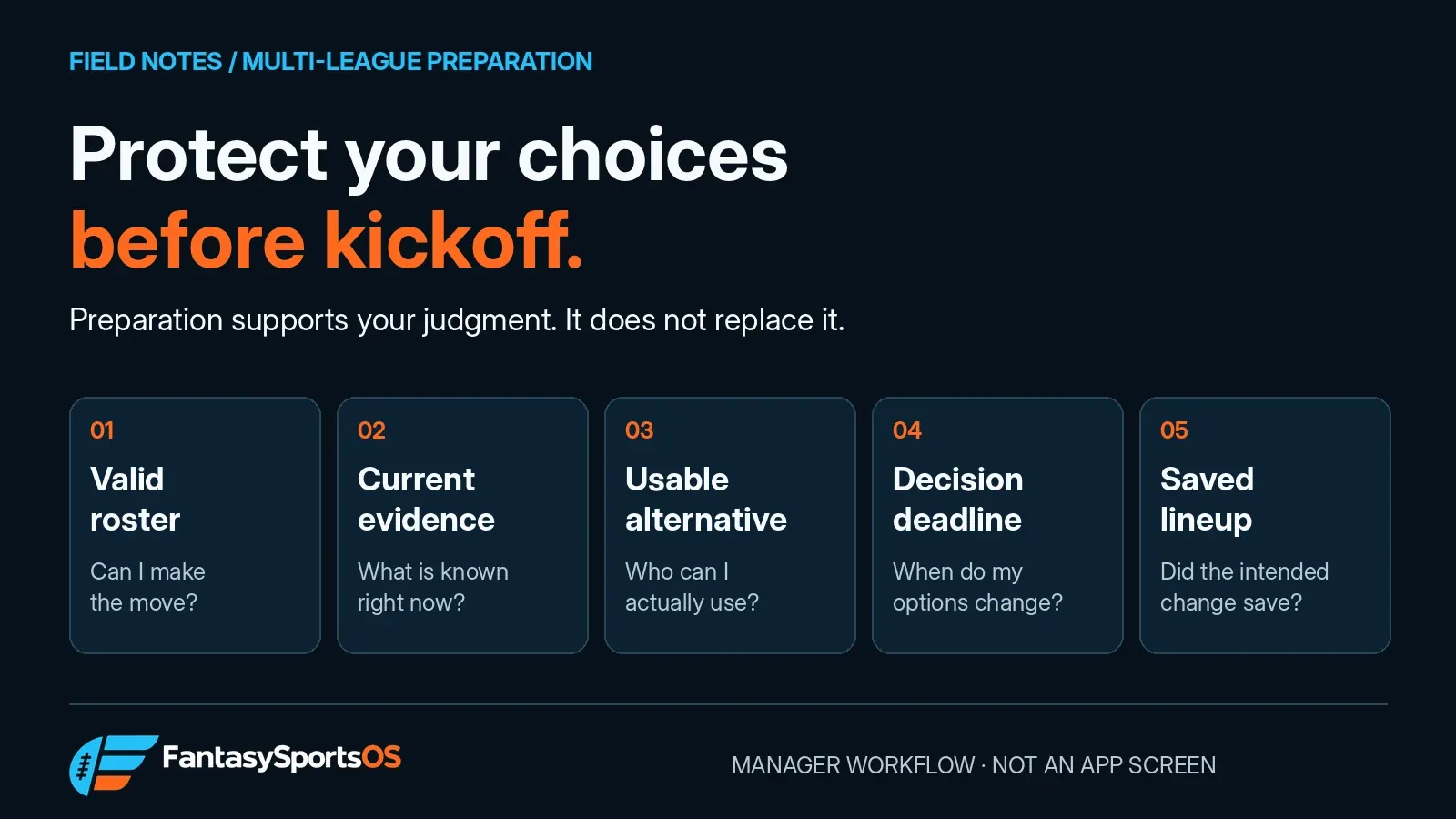
A checklist does not replace decision-making. It keeps avoidable mistakes from getting in the way of the decisions that matter.
You can make a sound football decision and still lose the chance to use it.
A replacement can stop being available. A roster restriction can block a move. The change you intended to make can remain exactly that: an intention.
A pre-kickoff checklist is not about pretending to predict the game. It is about protecting the choices you still have.
What should a multi-league manager check before kickoff?
Confirm that each lineup is valid, verify the current information behind uncertain starters, identify usable alternatives, and review the deadlines that could remove those alternatives. Make the chosen changes in Sleeper and confirm they saved.
Keep later-game questions on a specific follow-up plan rather than treating the first kickoff as the end of the work.
The working checklist
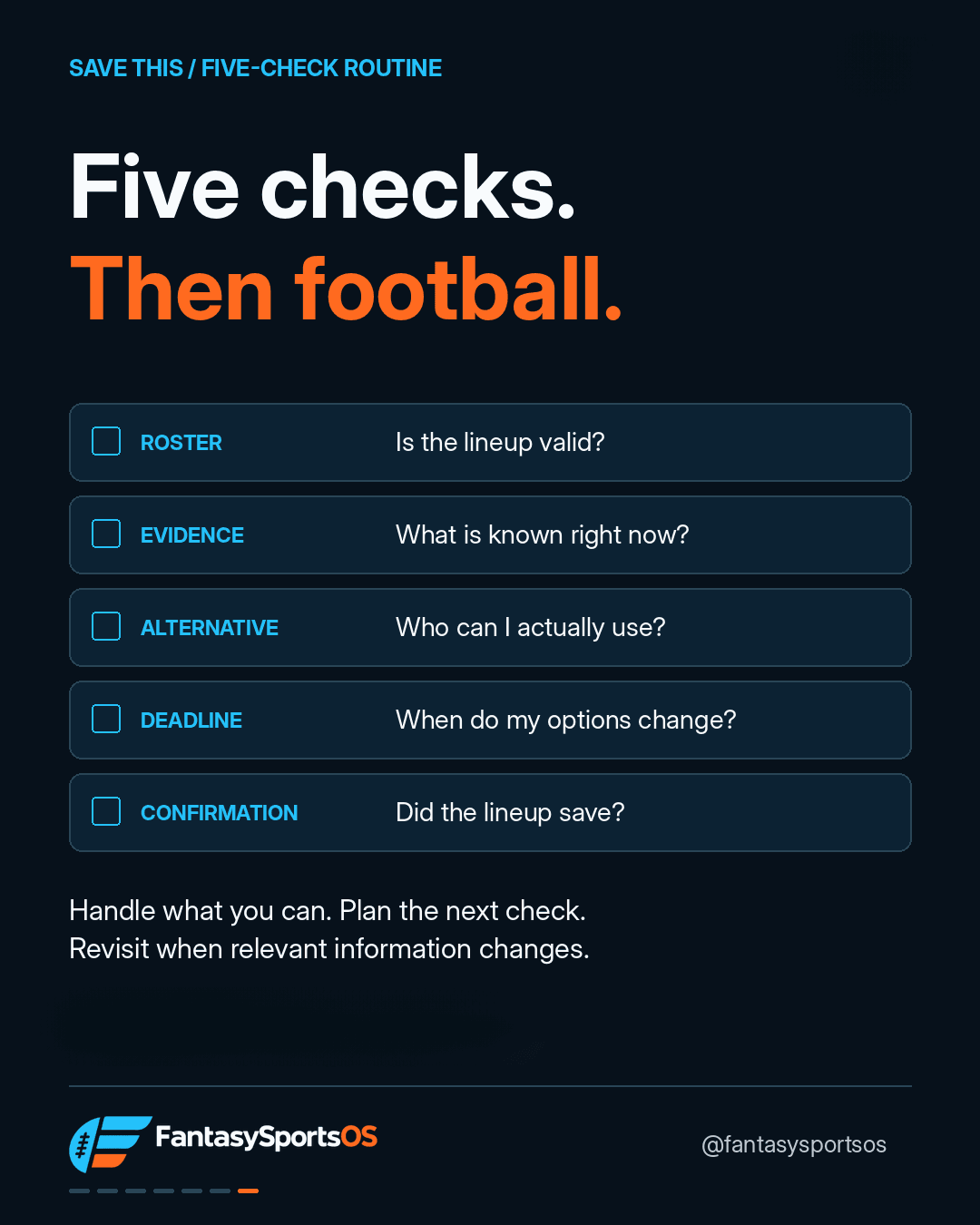
1. Make sure the lineup can actually be changed
Check your starting positions and bench. Look for empty slots, bye-week players you did not intend to start, and unresolved roster restrictions.
On Sleeper, a player who no longer qualifies for your league’s IR slot can restrict roster activity until the issue is resolved. Review your league’s eligibility settings rather than assuming a familiar injury tag always works the same way.
Do that before the moment you urgently need a replacement. A good fallback is not useful while a preventable roster problem blocks the move.
2. Verify the evidence behind uncertain starters
Read the latest relevant official team information and the context of any reporting you rely on. Note when it was issued. A copied headline with no clear timestamp should not outrank a newer, identifiable source.
Separate the questions “Can he participate?” and “Do I prefer him to this alternative?”
Confirmation of availability does not settle the football decision.
When a status remains unresolved, do not manufacture an answer. Move to the next part of the checklist: what you can do while that uncertainty exists.
3. Name a usable alternative in each league
Check that the replacement is actually on your roster or obtainable under that league’s rules. Confirm position eligibility and whether the relevant lineup slot remains available.
A player who looks useful on a rankings page is not necessarily a player you can use today. Waiver settings and acquisition timing differ by league.
For manual changes, also respect game-start locks. A newly added player still needs an eligible lineup position and a game that has not already locked.
4. Protect flexibility before the deadline
Where your format and lineup rules allow it, place earlier-playing starters in their dedicated positions and preserve broader FLEX eligibility for later choices.
This is a conditional strategy. It helps only when the relevant players and slots remain movable and the alternative qualifies.
Do not turn “keep the late player in FLEX” into a rule you follow without looking at the actual roster.
AutoSubs deserve a separate check. In Sleeper leagues that enable Player AutoSubs, an assigned eligible replacement can cover an inactive starter. Review the league’s AutoSub settings before relying on that plan, especially the timing and eligibility rules for the pairing.
Do not apply manual-swap assumptions to a pairing that is already locked.
5. Confirm the move and keep the remaining appointment
After editing, inspect the lineup in Sleeper. Verify the intended player and slot—not just that you tapped a button.
If a later-game question remains, record the next evidence to check and the last useful decision point. Set your own reminder through a method you trust.
Return to the unresolved question when its trigger arrives. You do not need to restart every completed review because one later starter remains uncertain.
When are you finished?
For the current review window, you are finished when the available decisions are handled and the unresolved ones have a viable next step.
That is different from declaring the entire week safe.
Keep a final check close enough to the relevant deadline to catch material changes while leaving enough room to act.
The point of preparation is not to stare at the app with greater intensity. It is to know what is done, what is not, and when you need to return.
Common questions
Does this checklist guarantee an optimal lineup?
No. It addresses execution and readiness, not perfect player forecasts. You still make the final decision between uncertain football outcomes.
Is Sunday morning the only time this matters?
No. Use the actual game and transaction windows for your players. Earlier games and later replacement options can require separate checks.
Does FSOS make these moves for me?
No. FSOS helps organize the context relevant to your decisions. You remain the decision-maker, and lineup changes happen in Sleeper.
Handle the available decisions. Put a time on the unresolved ones. Then watch some football.
Sources
A clearer view of your whole portfolio.
Apply for FSOS early access.