
guide
How to Manage Multiple Fantasy Football Leagues as One Portfolio
Manage multiple fantasy football leagues by grouping player situations, checking affected lineups, and prioritizing available actions and deadlines.
Published · Updated
Managing multiple fantasy football leagues starts with grouping decisions by player situation, then checking what each affected team needs. Review starters, bench spots, and roster options together. Prioritize available moves and deadlines, record what you decide, and revisit the situation when something changes.
Your portfolio is simply the collection of teams you manage. Looking across those teams does not mean making the same move everywhere. It means reviewing one situation with all the relevant league context in view.
One update. Several different decisions.
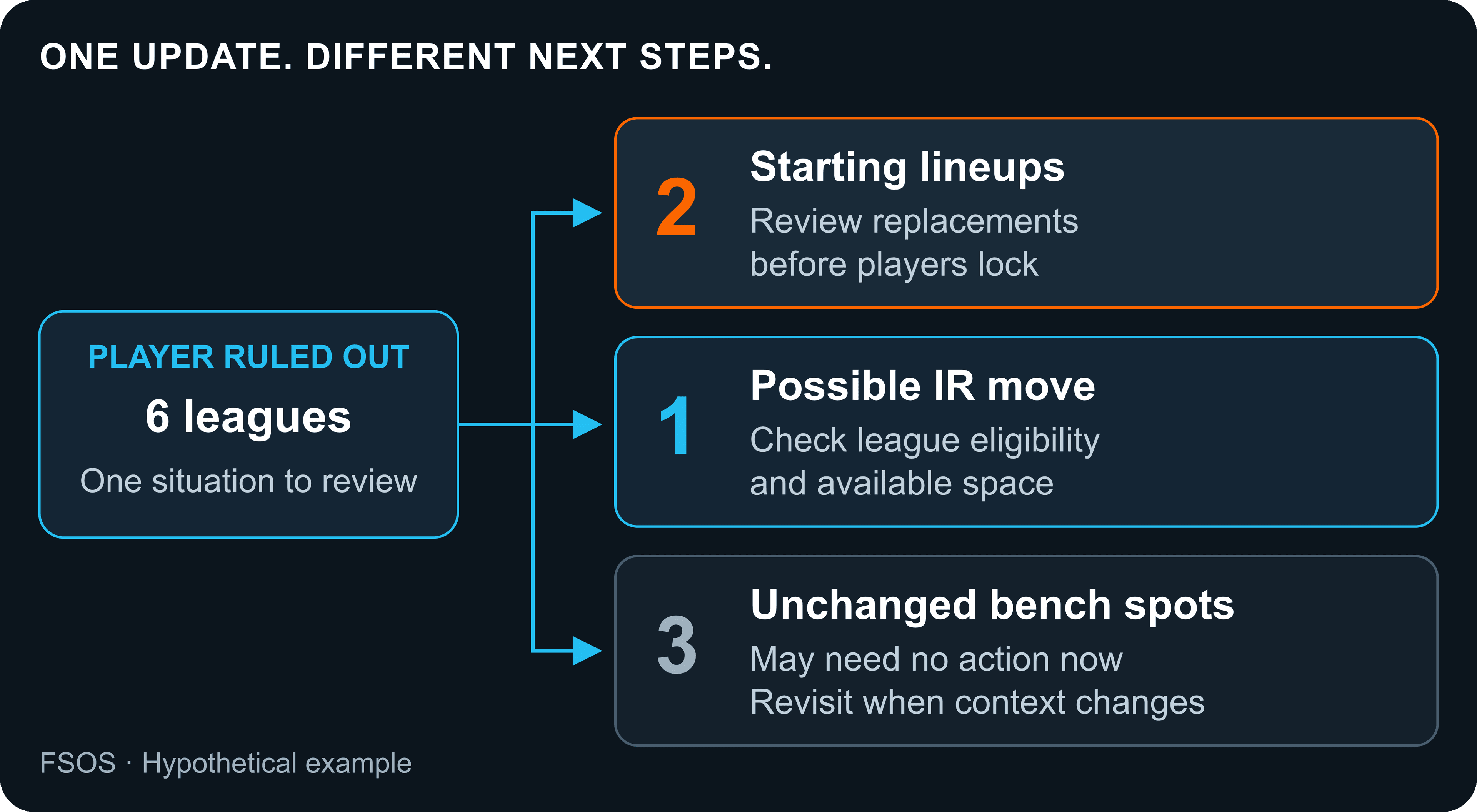
Consider a hypothetical example: a running back you roster in six leagues is ruled out.
In two leagues, he is in your starting lineup. In three, he is already on the bench. In the sixth, an eligible move to injured reserve might open a roster spot.
That is one piece of information—but it is not six equally urgent decisions.
The starting lineups need a replacement before their players lock. The potential IR move needs a check of that league's rules and available space: being ruled out does not automatically make a player IR-eligible in every league. The unchanged bench spots may need nothing from you today.
When you manage each league as a separate inbox, the important part is easy to lose: what changed, where it matters, and what you can actually do about it.
Start with the situation, then check the league context
A useful first question is not “Have I checked all my leagues?” It is “Which situations could change what I do?”
Group those situations by player or issue. Then review the affected leagues together.
The grouping is a way to organize attention, not a reason to make the same move everywhere. A replacement who belongs in a standard flex spot may not be your best option in a tight-end-premium league. A redraft roster and a dynasty roster can justify different choices. Waiver rules, available players, lineup slots, and deadlines still matter.
One situation can deserve one review and several different answers.
Separate exposure from urgency
Exposure tells you how widely a situation reaches across your portfolio. Urgency tells you how soon it needs attention.
A player on eight benches represents substantial exposure. A player in one starting slot with a deadline approaching may demand the earlier action.
Buy-ins can add useful context, too. They should not silently replace your priorities: a lower-stakes league you care about may matter more to you than a higher-stakes league you barely follow.
A practical order for reviewing a situation is:
- What is confirmed, and what is still uncertain?
- Where is this player rostered—and starting?
- Which leagues have a move available or a deadline approaching?
- What changes in each league's format or alternatives?
- Which decisions have I already handled?
Give “nothing to do” a place
While testing FSOS with my own teams, I questioned why benched players with unchanged injury statuses were still appearing at the front of the decision queue. The issue was not a lack of information. It was whether that information called for my attention right then.
Not every injury designation, depth-chart update, or headline deserves another decision card.
An unchanged bench situation is different from a newly unavailable starter. Keeping both at the front of the queue makes it harder to recognize the work that matters.
Once you have reviewed a situation, record what you decided. Revisit it when something material changes: a new status, a lineup change, or an available roster move. Check it again for the next week's lineup, too; last week's answer may no longer fit. A repeated headline alone is not a new action.
This does not mean ignoring uncertain information. It means distinguishing something worth watching from something you need to act on now.
A calmer weekly routine
Before lineup deadlines, review new situations across the portfolio. Work through the affected leagues, make the changes in your league platform, and verify the resulting lineups.
After the week's games, look for patterns across your teams. Where did the same lineup choice affect several results? Which positions lacked alternatives? What deserves a closer look next week?
The aim is not to turn fantasy football into a wall of metrics. It is to use the right context to make your next decision more clearly.
That is the idea behind FantasySportsOS: many leagues, one portfolio. The manager keeps the judgment. The system should make the important situations easier to see.
Managing several leagues? Apply for FSOS early access. Admission is invite-only; submitting an application does not create an account or guarantee access.
A clearer view of your whole portfolio.
Apply for FSOS early access.